

Poached eggs can lose their shape as soon as they enter hot water. Thin strands of egg white spread across the pot, leaving less white around the yolk. Stirring the water into a whirlpool may help gather the egg, but another method involves adding vinegar before cooking.
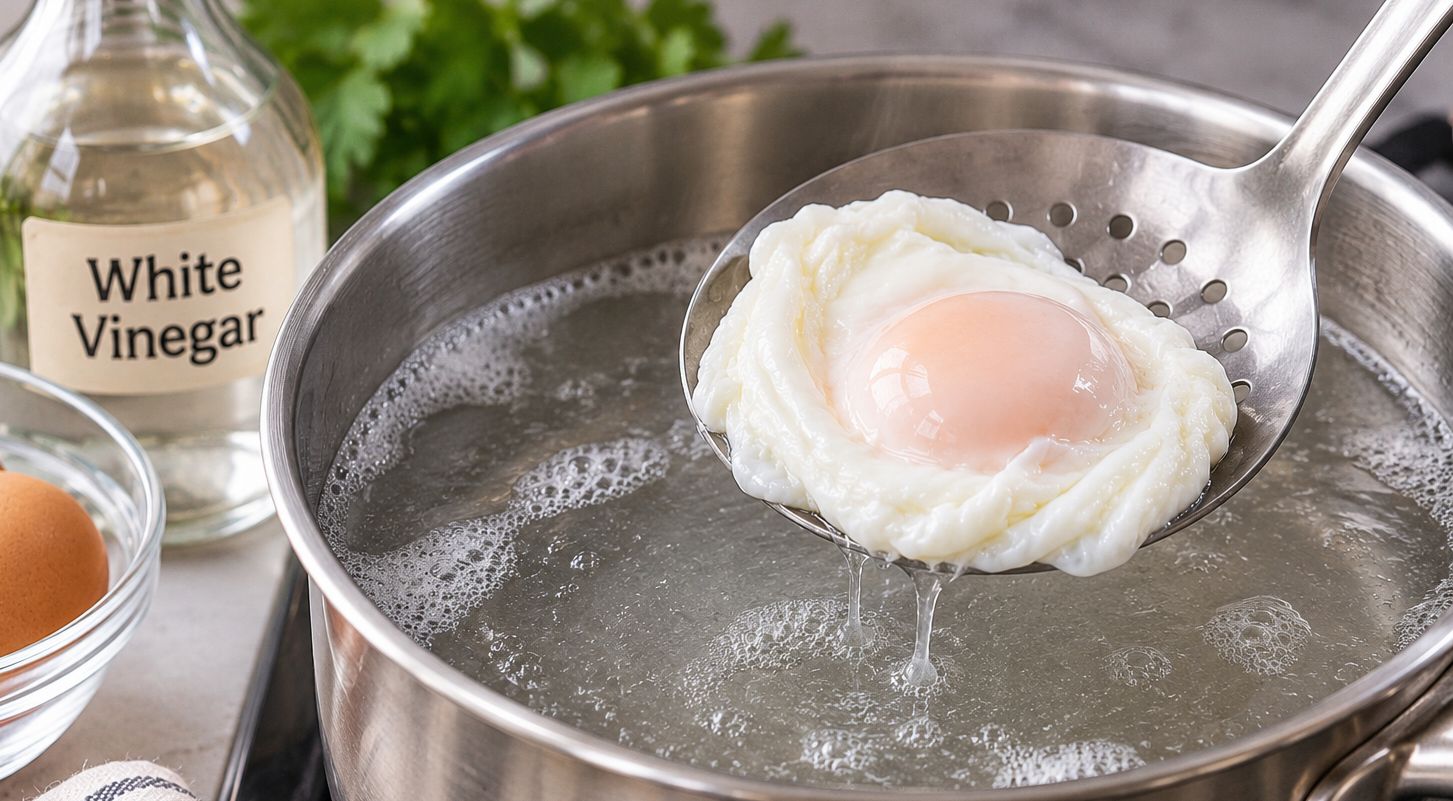
Vinegar contains acetic acid, which lowers the pH of the water. The change affects how egg-white proteins unfold and bond when exposed to heat, helping the whites set around the yolk.
The method requires a small amount of vinegar and water kept at a gentle simmer. It can help reduce spreading, although egg freshness and water movement also affect the finished shape.
Vinegar Changes How Egg Whites Set in Hot Water
Egg whites contain water and proteins, including ovalbumin, that change structure as temperatures rise.
During cooking, these proteins unfold and form bonds with one another, turning the transparent liquid into an opaque white mass.
Adding vinegar makes the poaching water more acidic, which can encourage proteins near the egg’s surface to coagulate.
This helps the outer white set before it disperses through the water.
Without enough structure forming around the yolk, loose egg white can separate into thin strands that float through the pot.
Vinegar doesn’t thicken the raw egg or prevent every strand from escaping. Older eggs tend to have thinner whites that spread more than those from fresh eggs.
Using too much vinegar can also affect the egg’s flavor. A small amount is enough to change the water’s acidity without making the finished egg taste sour.
How to Add Vinegar Before Poaching Eggs
For two poached eggs, use:
- 2 fresh eggs
- 1 tablespoon white vinegar
- Approximately 1 liter (4 cups) water
Fill a saucepan with water and bring it to a gentle simmer rather than a rolling boil.
Add the vinegar and stir to distribute it through the water.
Crack each egg into a separate small bowl or ramekin. This makes it easier to lower the egg into the pot without breaking the yolk.
If the egg contains a large amount of thin, watery white, strain it through a fine-mesh sieve for a few seconds before cooking. Removing that loose portion can help produce a more compact shape.
Lower the bowl close to the water and slide the egg into the saucepan.
Keep the water at a gentle simmer so the whites can set without being pulled apart by strong bubbling.
Cook for approximately 3 to 4 minutes for a set white and soft yolk, adjusting the time according to egg size and the desired texture.
Lift the egg with a slotted spoon and allow excess water to drain before serving.
For food safety, the FDA recommends cooking eggs until both the white and yolk are firm. Soft-yolk poached eggs carry additional risk, particularly for pregnant people, young children, older adults, and people with weakened immune systems. Pasteurized eggs are an option for dishes served with soft yolks.
Vinegar helps the proteins set, but it cannot compensate for vigorous boiling or eggs with thin whites.
Adding vinegar changes the acidity of the poaching water, helping egg whites coagulate around the yolk instead of spreading across the saucepan.
Sources: Exploratorium — Science of Eggs, American Egg Board — Egg Science, FDA — What You Need to Know About Egg Safety

Leave a Reply